
Service Detail
Commercial Artificial Turf in Mesquite, TX
Artificial Turf of Mesquite installs commercial synthetic turf for businesses along the Town East corridor, the US 80 commercial strip, FM 548 in Forney, and throughout the east Dallas County commercial market. We install to commercial-grade specification — higher face weight, durable infill, drainage designed for traffic load — and we work around business operations to deliver finished surfaces without closing your property.
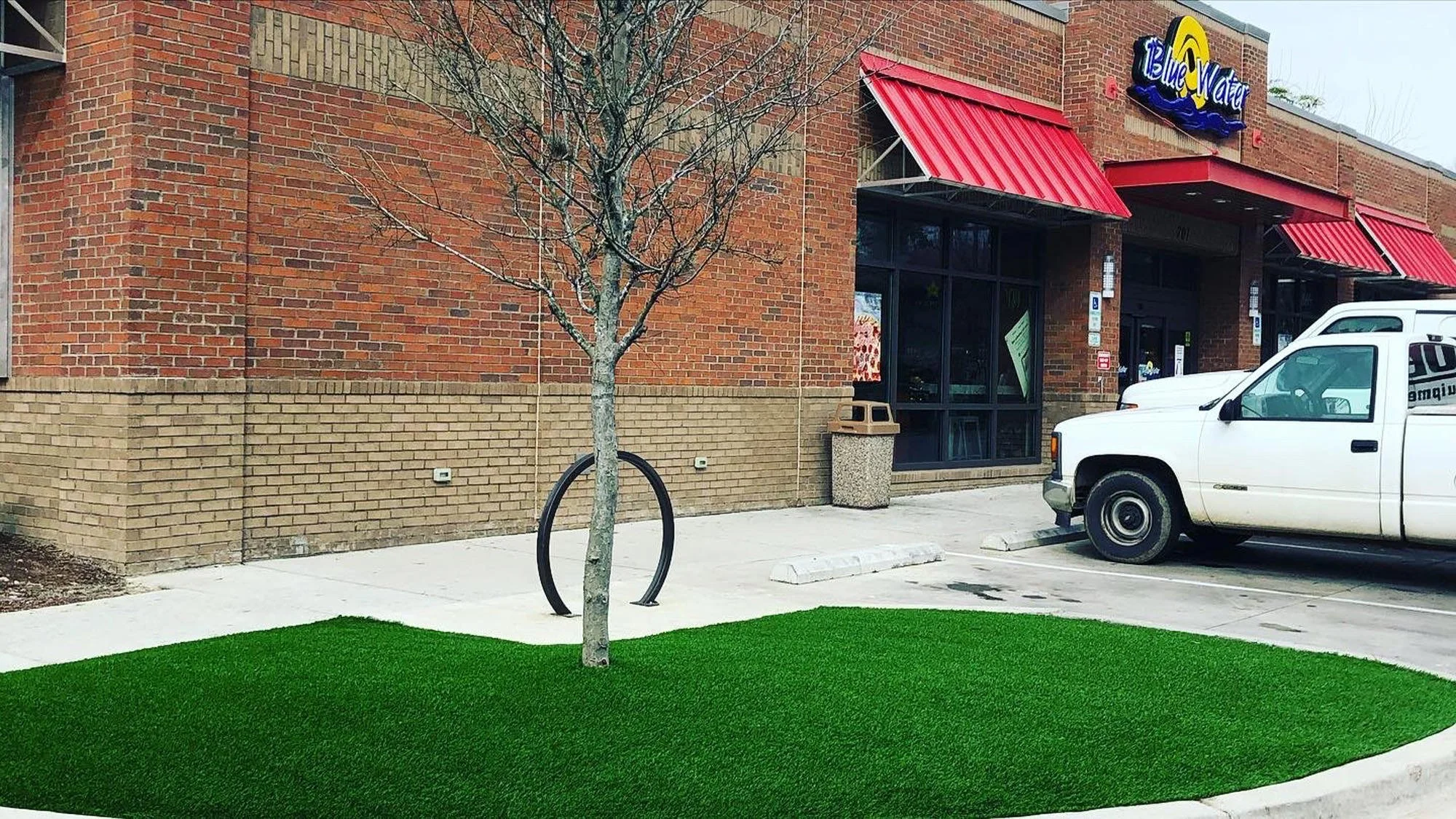
Commercial Turf in the East Dallas County Market
The Town East Mall corridor, the US 80 commercial strip through Mesquite, FM 548 and US 80 through Forney, and the rapidly developing commercial zones in Crandall and Kaufman County share a consistent commercial landscape challenge: natural grass in these high-traffic, high-heat environments requires irrigation budgets and maintenance crew commitments that most small and mid-size businesses operating in this market cannot sustain at the level needed to maintain consistent exterior appearance. Artificial Turf of Mesquite serves commercial property owners and managers throughout this corridor with installations sized and specified for business-environment use — not residential-weight products applied to commercial applications.
- Commercial-grade face weight and density for high-foot-traffic applications
- Drainage engineered for east Dallas County clay-soil commercial sites
- Installation scheduled around business operations — no forced closure required
- Consistent exterior appearance year-round without landscaping crew dependency
- Town East Mall corridor, US 80 strip, and Forney FM 548 commercial zone served
- Property management and multi-site accounts handled
What Commercial Turf Delivers for East Dallas County Businesses
- Consistent Curb Appeal on the US 80 and Town East Corridors: Businesses along the US 80 commercial strip through Mesquite and the Town East Mall corridor compete for attention from drivers making drive-by purchase decisions. Exterior landscape appearance is part of the signal — a dead or patchy grass border communicates a different message than a consistently green and maintained surface. Commercial synthetic turf holds its appearance through August heat, winter dormancy windows, and the spring transition period when natural grass looks worst. The surface that greets customers in January looks the same as the one they saw in October.
- Eliminated Irrigation Cost on Commercial Properties: Commercial properties with significant irrigated landscape areas in east Dallas County carry irrigation costs that accumulate significantly over the summer season. Restaurant properties along the Town East corridor with high-traffic parking perimeters and entry areas, retail centers with large entry median landscapes, and medical office complexes with extensive entry plantings all run irrigation systems that consume commercial-rate water through the six-month Texas irrigation season. Synthetic turf eliminates that cost category entirely — a recurring saving that compounds against installation cost from the first summer forward.
- Reduced Landscaping Crew Dependency: Commercial landscaping crew scheduling in east Dallas County has become less reliable and more expensive as labor availability has tightened in the broader market. Businesses that depend on weekly mowing and trimming services to maintain exterior appearance face real risk of missed service windows that leave properties looking neglected during the intervals between visits. Synthetic turf reduces the landscape crew requirement to periodic debris blowing and occasional rinsing — maintenance that can be handled by existing facilities staff without specialized equipment.
- Daycare and School Exterior Play Areas: Daycare facilities, private schools, and after-school programs in east Mesquite and the Forney corridor represent a specific commercial synthetic turf application where the performance requirements are different from standard retail or office installations. Play area turf needs antimicrobial infill, cushioned backing for fall safety, and a surface that can be sanitized between use periods. We install play-area grade synthetic turf for childcare commercial properties with specifications matched to the application, not standard commercial stock.
- High-Traffic Entry and Perimeter Areas: The highest-wear zones on commercial properties — entry areas, parking lot perimeters, drive-through borders, and outdoor seating transitions — are exactly the zones where natural grass fails first and fails fastest. Commercial synthetic turf with face weight appropriate for high foot traffic holds its profile through the concentrated use that commercial entry zones experience without developing the flat, compacted appearance that lower-grade turf develops within two to three seasons.
- New Forney and Crandall Commercial Development: The commercial development following Forney and Crandall's residential growth has added businesses that are making first-time exterior landscaping decisions. Property owners in new Forney retail and commercial developments along FM 548 and FM 1641 have the opportunity to skip the natural grass establishment cycle entirely and install commercial synthetic turf on day one. We work with new commercial construction on a timeline that coordinates with overall property completion rather than as a retrofit after natural grass has already failed.
How We Handle Commercial Turf Projects in the East Dallas County Corridor
Commercial installations require project management that residential work does not — phased access, business-hours scheduling, coordination with property management, and clean handoffs at each phase.
Commercial Site Assessment and Scope Development
We meet with property owners, managers, or facility directors to walk the installation area, assess access constraints, identify drainage and soil conditions, and understand operational parameters — what hours are accessible, which areas must remain open, what the timeline requirement is. The commercial scope and proposal come directly from this assessment.
Commercial-Grade Product Specification
We match product to application. Restaurant patio borders, retail entry medians, daycare play areas, and industrial-frontage strips each have different face-weight, pile height, infill, and backing requirements. We do not apply a single commercial product regardless of application — the specification matches the traffic load, UV exposure, and use requirements of the specific commercial site.
Phased Installation Planning
For commercial properties that cannot close completely during installation, we plan phased sequences that keep customer-facing areas accessible while installation proceeds. Entry areas may install after hours; parking perimeters during low-traffic windows; interior courtyard sections during standard business hours if customer flow patterns allow it. We coordinate the phase plan with the property manager before mobilization.
Site Preparation and Base Work
Commercial site preparation addresses existing vegetation removal, excavation to commercial base depth, compacted aggregate installation, and drainage engineering appropriate for the site's soil conditions. Commercial base specifications typically call for deeper aggregate than residential applications given the higher traffic loads.
Turf Installation and Perimeter Finish
Commercial turf is installed with close attention to edge and perimeter details that affect the property's professional appearance. Concrete curb transitions, paver borders, hardscape-to-turf transitions, and parking lot curb adjacent edges are all finished to commercial-appearance standards.
Final Inspection and Property Manager Handoff
Final walkthrough with the property manager or owner. We document the installation, provide care and maintenance guidance specific to commercial use, confirm drainage performance, and close the project with written records of product specification and installation standards for the property file.
Commercial Installation Capabilities
- Commercial-grade face weights from 60 oz to 90+ oz per square yard
- Traffic-appropriate pile heights for each application type
- Drainage engineering for east Dallas County commercial site soil conditions
- Business-hours installation scheduling for occupied properties
- Restaurant, retail, medical, daycare, and industrial applications
- Property management account coordination for multi-site projects
- New commercial construction timeline coordination
- Forney and Crandall new-development commercial service
Commercial Turf Questions from East Dallas County Property Owners
Can you work around our restaurant's operating hours?
Yes. We regularly install commercial turf on schedules that work around restaurant operating hours — morning installations before opening, evening work after closing, or phased daytime installation that keeps customer-facing areas accessible while we work sections in sequence. We discuss the operational constraint during the site assessment and build the installation schedule around it.
Our Town East corridor retail property has clay soil and drainage problems. Can that be corrected?
Clay-soil drainage issues in the Town East corridor are addressable with appropriate base depth and drainage engineering. We assess the specific drainage problem — whether it is surface grade, base compaction, or subsurface restriction — and design the base system to correct it. We have handled drainage correction as part of commercial installations on Town East corridor properties where previous landscaping approaches failed for exactly this reason.
We are opening a new Forney location. Can you install commercial turf on a new construction timeline?
Yes. New commercial construction is a good context for synthetic turf installation because it allows us to coordinate with the general contractor on site access and schedule turf installation as part of the landscaping phase rather than as a retrofit. We work with new Forney commercial developments on timelines that align with property completion and permitting.
How does commercial turf hold up in high-foot-traffic entry areas?
Commercial-grade synthetic turf at appropriate face weight is engineered specifically for concentrated pedestrian traffic. The key specification is face weight — residential-weight products (40 to 50 oz) will flatten and mat in commercial entry traffic zones within a few seasons. Our commercial installations use face weights matched to the expected traffic load, which for high-use entry areas typically starts at 70 oz and goes higher for very heavy use applications.
Does commercial turf require ongoing maintenance contracts?
Commercial synthetic turf requires minimal maintenance compared to natural grass — periodic debris blowing, occasional rinsing, and annual professional inspection. Facilities staff can handle routine maintenance without specialized equipment. For properties that prefer a contracted maintenance schedule, we offer annual maintenance agreements that include professional inspection, infill assessment, and any minor repair identification.
What is the typical commercial installation timeline from contract to completion?
Standard commercial installations — entry areas, parking perimeters, retail medians — typically complete in two to five days of on-site work. Larger commercial projects or phased installations on occupied properties extend this timeline based on the phase schedule. We provide an installation timeline as part of the commercial proposal.
Related Services
Artificial Turf Installation
Professional Artificial Turf Installation in Mesquite, TX.
Artificial Turf Maintenance
Professional Artificial Turf Maintenance in Mesquite, TX.
Synthetic Grass Cleaning
Professional Synthetic Grass Cleaning in Mesquite, TX.
Pet Friendly Artificial Turf
Professional Pet Friendly Artificial Turf in Mesquite, TX.
Schedule a Commercial Site Assessment
Artificial Turf of Mesquite handles commercial synthetic turf projects throughout the east Dallas County corridor. Call or submit a request to schedule a commercial site assessment. We respond same business day and can typically schedule the assessment within the week.